
Gonna Get Myself Connected
The connected store is now a reality but how did it evolve and what's next?

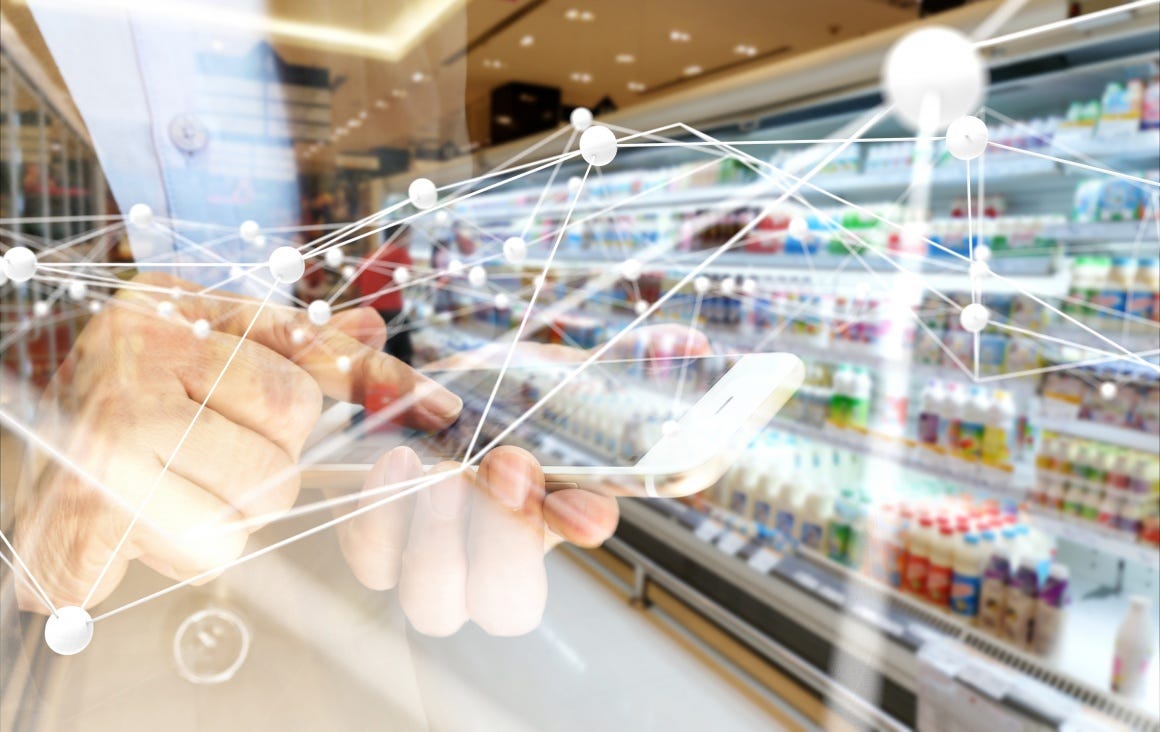
The Evolution of the Connected Store: From Analogue Aisles to AI‑Native Retail
Retail has always been a mirror of society, shaped by technology, behaviour, and the relentless pursuit of efficiency. Today, AI dominates just about every retail conversation, however, close behind, the talk now is all about the connected store.
But it didn’t happen overnight.
It emerged through six distinct eras, each laying the foundations for the next. Today’s connected store is not a piece of hardware or a software platform; it’s an operating model. And its evolution is important to understand because it serves to indicate where retail is heading next.
1. Manual Retail → Early Automation (1950s-1970s)
For decades, retail was entirely analogue. Prices were stamped, stock was counted by hand, and the checkout was a mechanical till. The breakthrough came in 1972 with the first barcode scan, a moment that transformed retail forever. Suddenly, products could be identified instantly, transactions could be recorded digitally, and the seeds of automation were sown.
The barcode didn’t just speed up checkout; it created the first machine‑readable retail environment. It was the moment the store began talking to the back office.
2. Digitisation & Data Foundations (1980s-2000s)
As electronic POS systems spread, retailers gained access to something they’d never had before: data. Sales patterns, stock levels, shrink, loyalty behaviour, all captured, stored, and analysed. ERP systems emerged, centralising operations and giving retailers a single version of the truth.
But these systems were siloed. Data existed, but it didn’t flow. Stores were digitised, but not yet connected.
3. Omnichannel & Mobile Commerce (2000s-2015)
The rise of e‑commerce forced retailers to rethink the store’s role. Customers wanted to browse online, collect in‑store, return anywhere, and pay however they liked. The store became a node in a wider network - part showroom, part fulfilment hub, part service centre.
Mobile payments, endless aisle, and click‑and‑collect blurred the boundaries between digital and physical. For the first time, the store wasn’t just a destination; it was part of a journey.
4. Sensor‑Driven, AI‑Enabled Stores (2015-2023)
RFID, computer vision, smart cameras, and IoT sensors turned stores into data‑generating environments. Retailers could track items in real time, automate replenishment, reduce shrink, and understand customer behaviour with new levels of precision.
Automated checkout emerged, proving that friction wasn’t a necessity. Associates gained mobile tools that guided tasks, surfaced insights, and reduced cognitive load.
The store became intelligent.
5. The Connected Store Operating Model (2023-Present)
Today, the connected store is a real‑time operating system. Signals from POS, cameras, sensors, payments, and devices flow into a unified layer that orchestrates colleagues, customers, and enterprise systems.
Associates receive guided workflows. Managers see live operational health. Shrink, uptime, and energy become measurable and manageable. The store becomes a dynamic, intelligent node in the retail network, not just a static asset.
6. What’s Next: AI‑Native Retail (Emerging)
The next evolution is already forming. AI‑native stores will autonomously forecast demand, plan labour, optimise replenishment, and adjust pricing. Spatial computing will guide colleagues and customers. And payment will be by fixed POS, mobile POS or SCO, sitting seamlessly alongside each other serving the different customer journeys.
In this world, the store becomes a self‑optimising system and data hub - always learning, always improving.